

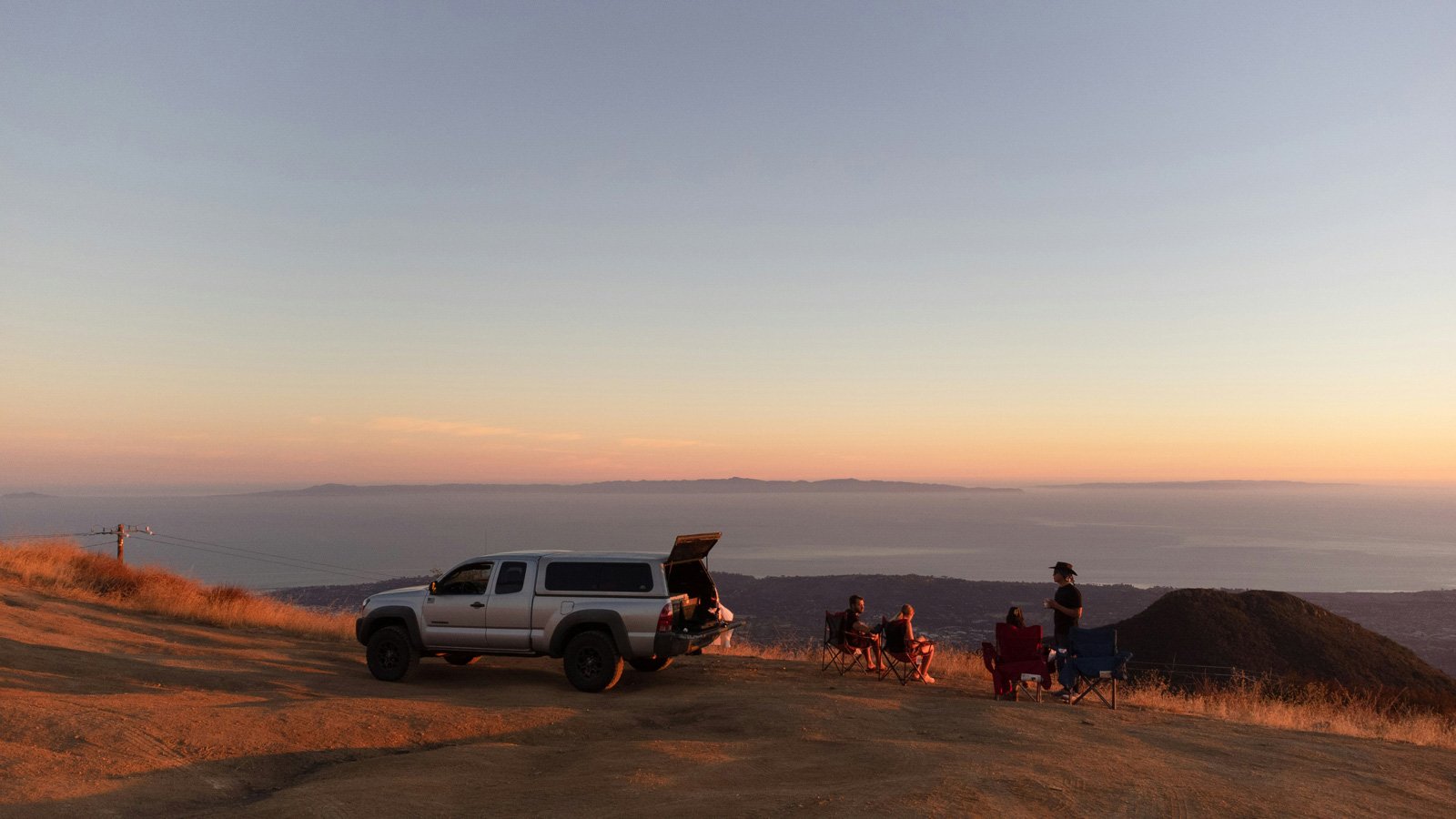
While the desert floor bakes and the campgrounds fill, the mountains open. Here’s how to follow the elevation and find your best summer sites.
Somewhere around the second week of June, the low-elevation boondocking gets hard. Not impossible — but hard. The canyon sites that were perfect in April are now radiating heat by nine in the morning. The desert pullouts that felt like secrets in March are either posted with closure signs or packed with people who found them on iOverlander. The nights that used to drop into the fifties now stubbornly hold at seventy-four. You lie in your rig with the MaxxAir running full bore and wonder why you didn’t just rent an RV park spot.
The answer isn’t to give up. The answer is to go up.
The Elevation Equation
It’s one of the most reliable rules in western boondocking: every thousand feet of elevation gains you roughly three to five degrees of cooling. Park at 4,000 feet in southern Utah when the valley floor is sitting at 105°F and you’re looking at something in the mid-eighties. Push to 7,000 or 8,000 feet — which is easily achievable across most of the Mountain West — and you’re in the low seventies during the day and fifties at night. Add a breeze off the ridgeline and you’re reaching for a layer by sundown.
The Forest Service and BLM both manage enormous swaths of high-elevation dispersed camping land that the average RV tourist never touches, partly because the roads require a little more confidence to navigate and partly because most people don’t know the sites exist. That gap is your advantage.
Where to Look Right Now
In the Northern Rockies — Montana, Idaho, Wyoming — dispersed sites above 6,000 feet on National Forest land are opening up throughout June as snowpack recedes. The Gallatin National Forest around Big Timber, Montana, the Salmon-Challis in central Idaho, and the Bridger-Teton in western Wyoming all have extensive two-track access that comes into its own right around now. Road conditions can shift fast after a wet spring, so check the district ranger station’s road closure map before you commit to a multi-day run — a quick phone call to the local ranger district is still the most reliable intel you’ll get.
In Colorado and northern New Mexico, the San Juan National Forest and Carson National Forest hold some of the most accessible high-country dispersed camping in the country. Elevations in the 9,000-to-11,000-foot range are achievable in a well-set-up truck camper or overland rig, and the weather at those altitudes is genuinely cool — sometimes cold — right through July. Afternoon thunderstorms are a daily reality above 10,000 feet from late June through August, so you camp in the trees, not on exposed ridges, and you’re back in the rig by two o’clock.
In the Pacific Northwest, the Okanogan-Wenatchee and Gifford Pinchot National Forests in Washington are mid-June gold. Access roads that were gated all winter start coming down in late May and June, and the dispersed sites that open up are, in many cases, genuinely spectacular — old-growth fir and pine, high meadows, creeks running cold off glacier melt.
The Window Problem
High-elevation boondocking in summer comes with one catch: the window is real, and it closes. Many of the best dispersed sites above 7,000 feet in the Rockies are inaccessible until mid-June and start getting complicated again by late September when early snowfall can strand rigs overnight. Some years, the window is tight — a wet spring followed by an early fall can compress it to ten or twelve weeks. In other years, you get the whole glorious summer.
The practical response to this is to run your high-country sites earlier in the season rather than later. The weekend after the Fourth of July, the sites that were empty when you scouted them in late June will be double-occupied. Go now, while the roads are just opening, while the crowds haven’t found their seasonal groove yet. June 15 through June 30 is consistently one of the best two-week windows for high-elevation dispersed boondocking in the American West — the snow’s gone, the bugs haven’t peaked, and the sites are quiet.
Planning the Approach
A few things that matter more at elevation than they do in the desert. Water sourcing changes — you’re often near streams and snowmelt rather than tanks and stock ponds, which means a filter becomes more important than carrying extra capacity. The drop in temperature at night can surprise even experienced desert campers; even when the days are mild, pack a real sleeping bag, not your April shoulder-season kit. And if you’re running propane-powered cooking or heating, keep in mind that propane output drops at elevation — not dramatically, but enough to notice if you’re right at the edge of what your system can do.
Cell service goes away in a lot of these places, which is either a feature or a bug depending on your mindset. The ones who treat it as a feature tend to have a better time.
The mountains are open. The weather is mild. The sites are quiet right now, and they won’t be in six weeks. Go while the going is good.