

The importance of STOP THE BLEED® on the back road
This article originally appeared in the Fall 2026 edition of Boondocking Magazine.
By Patrick O’Neill

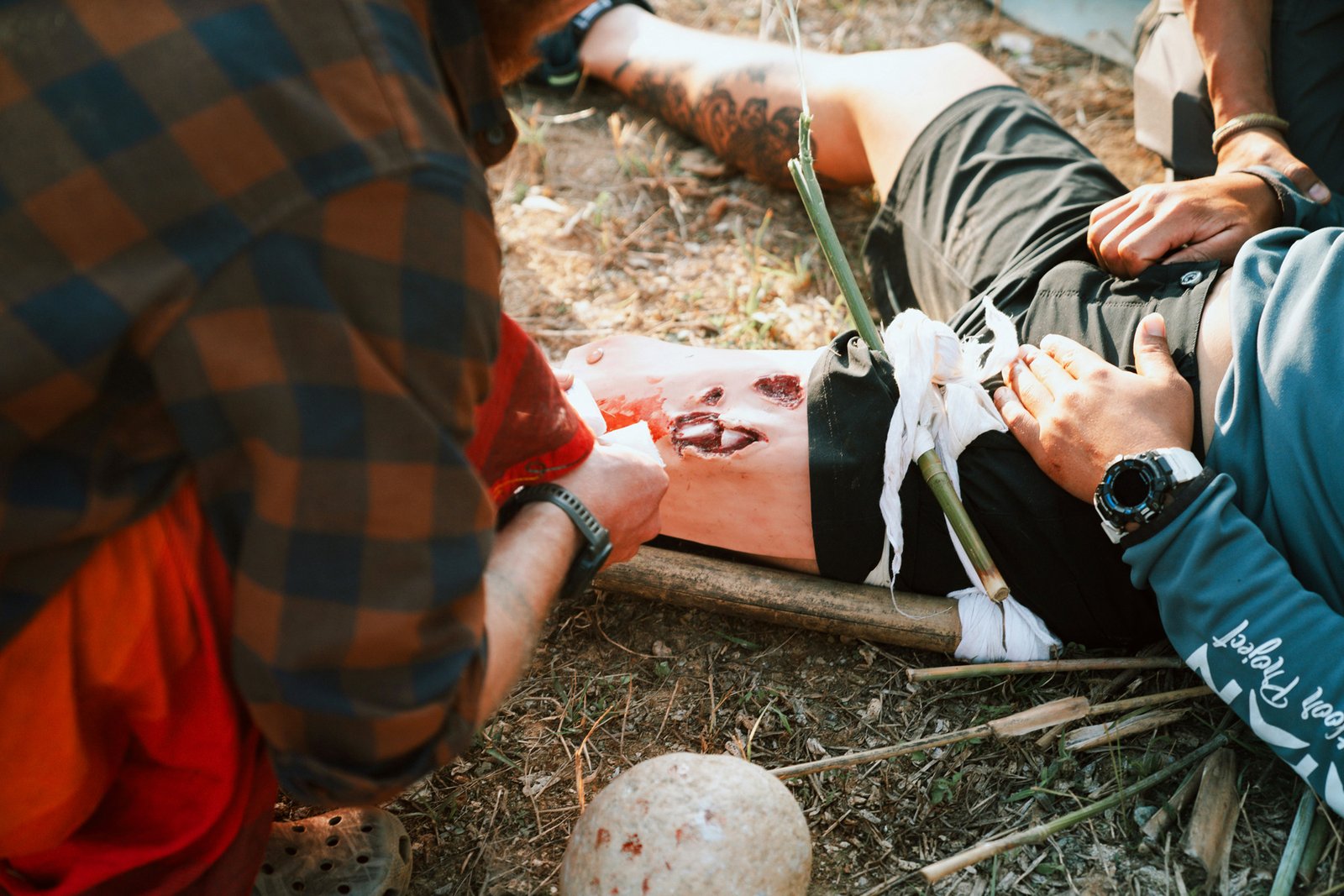
You picked the spot because nobody else was in it. Fourteen miles of washboard behind you, a creek running somewhere below the ridge, no bars on the phone, and no neighbors. That is the whole point. It is also worth thinking through before something goes wrong.
Severe bleeding kills faster than almost anything else you are likely to face out there. A serious arterial injury can bleed a person out in roughly three to five minutes. In town, a good ambulance response is seven to ten. On a numbered forest road with no address, dispatch has to work out where you actually are and then send a crew that may cover the last stretch on foot. Response time stops being measured in minutes and starts being measured in hours.
Nobody is coming in five minutes. The person who is going to save that life is already standing in your camp.
What the Military Learned, and Sent Home
Twenty years of war taught military medicine something important: the most common cause of preventable death in the field was not the injury itself. It was bleeding that could have been stopped with a tourniquet, a pressure dressing, and a pair of hands that knew what to do in the first few minutes.
So the military stopped treating it as a job only done by medics. Regular soldiers — infantry, drivers, mechanics, cooks — got the training and carried the gear. Deaths from uncontrolled bleeding dropped dramatically. This was a wakeup call for the whole medical profession, because it proved that people without a medical background could quickly learn what to do and help somebody in a bleeding emergency.
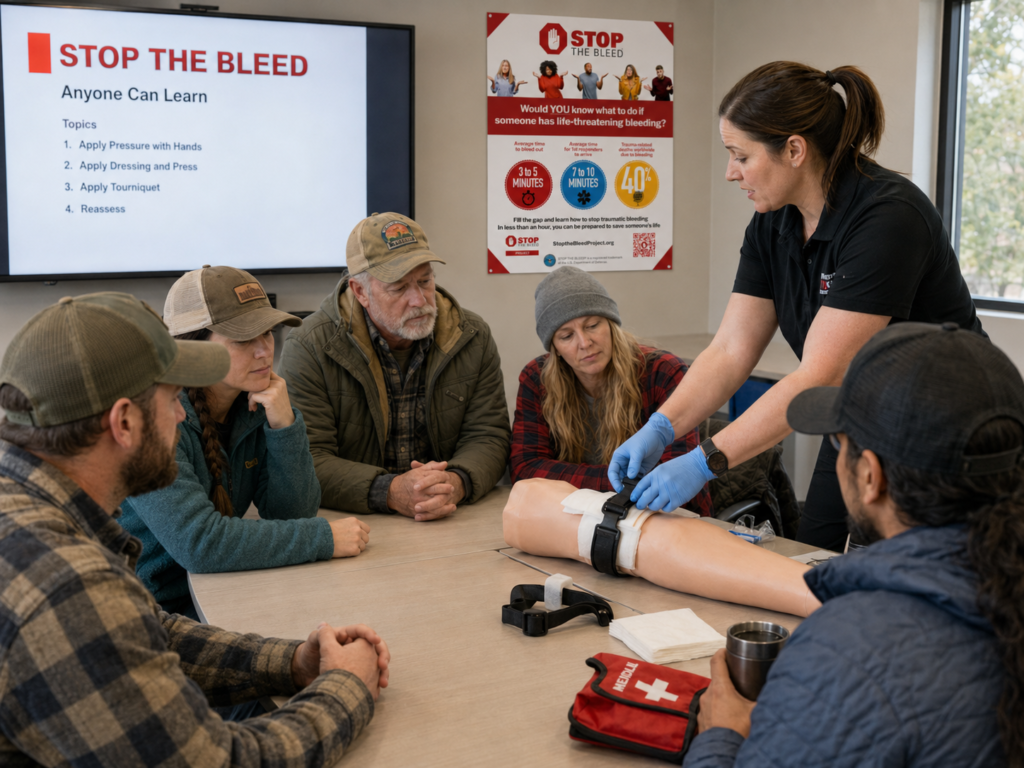
When those soldiers came home, they brought that knowledge with them. The shootings at Sandy Hook Elementary School and other mass casualty events clearly showed that a civilian version of the bleeding control training received by the military was needed. The U.S. Defense Department’s (DoD) STOP THE BLEED® Program was created to meet that need. It takes the hard-won knowledge acquired on the battlefield and makes it available to the rest of us. It is an official DoD program that teaches ordinary people the same core bleeding control skills in a class that takes about an hour.
This Is Not a “Mass Casualty” Thing
Ask most people what STOP THE BLEED® training is for and they will say something about an active shooter. Fair enough — that is where the public conversation started. But it has expanded quickly to all the other ways people experience life-threatening bleeding. Car accidents, mishaps at home and at work, sporting injuries, and everyday accidents make up the vast majority of life-threatening bleeding incidents.
The ones that happen to the Boondocking community are ordinary and entirely predictable. A chainsaw that skips off a wet log while you are clearing deadfall. A folding knife that closes on a hand. A UTV laid over on a side hill. An angle grinder, a snapped recovery strap, a jack that gives way. Add to that the two-lane road you drove in on, where you might be the first on scene at a wreck.
The Three Steps
Call for help — then keep working. In a dead zone that means a satellite messenger or a personal locator beacon. If your emergency communications plan is “drive out until I get a signal,” that plan works when you need a tow in the morning. It does not work for a bleeding emergency.
Find the bleeding. Blood hides in dark clothing and soaks away fast. Look, feel, and get the wound exposed. You cannot treat what you have not found.
Compress. Apply firm, direct pressure with both hands, and do not let up to check on it. If the wound is on an arm or a leg and pressure is not holding, a tourniquet goes on high and tight above the injury and gets tightened until the bleeding stops. It hurts, but it should stay on until a medical provider takes it off. If you can, write the time the tourniquet was applied on the tourniquet. For wounds in the groin, armpit, neck, or shoulder, where a tourniquet cannot be used, you pack the wound with gauze and hold pressure.
One Standard, Not a Shelf Full of Look-Alikes
Go shopping for bleeding gear or a class and you will run into a dozen names: bleed control, traumatic bleeding response, hemorrhage control, trauma first aid. Contents vary, curricula vary, and so does quality. STOP THE BLEED® is the only standardized civilian bleeding control system in the country, and the only one built on evidence developed and proven by the Department of Defense. One program, one set of training and equipment standards.
What to Carry, and Where to Put It
The gear is standardized the same way. The program defines exactly three kits, each named for what it lets you do.
STOP THE BLEED® Basic Kit. Nitrile gloves, a DoD-approved tourniquet, a compression bandage, wound packing gauze, a black marker, and an instruction card. Direct pressure, a tourniquet for life-threatening bleeding on an arm or a leg, and gauze for packing a deep wound. This is the entry-level kit for general preparedness.
STOP THE BLEED® Intermediate Kit. Everything in the Basic Kit, plus a DoD-approved hemostatic dressing that speeds clotting when you pack a deep or heavily bleeding wound.
STOP THE BLEED® Advanced Kit. Everything in the Intermediate Kit, plus a vented chest seal for a penetrating chest wound. This is the full-capability kit, covering all three of the major civilian bleeding emergencies.
Program kits carry tourniquets and hemostatic dressings approved by the Department of Defense for military use — the SOF-T, SAM-XT, TMT and CAT tourniquets among them. Online marketplaces are full of inexpensive, often foreign-made kits that look right, but may fail when the time comes to use them to save someone. Relying upon the STOP THE BLEED® standard is how you avoid finding out the hard way.
Storage matters just as much. You should avoid putting a kit at the bottom of a bin, under the generator, or behind the firewood. It belongs somewhere where you can put your hands on it very quickly — with life-threatening bleeding, every second counts. The cab of the truck, inside the camper door, or strapped to the quad all work. Carry a second one if there are two or more of you, because one of you might be the patient.
Then Take the Class
Gear without training does not make you prepared. Take a STOP THE BLEED® class. It is a small ask: about an hour, hands-on, no prerequisites, and frequently free or low cost through a local hospital, fire department, or emergency management office. Nothing else you can do in an hour buys as much capability for the people around you.
Find out more at DoDstopthebleed.org.
The Ethic You Already Have
Boondockers already carry traction boards, a spare belt, and enough water for a bad day. This is the same instinct, applied to the one emergency with the shortest clock on it. The rig parked a quarter mile down the two-track probably has no kit at all, and if that day goes sideways, you are the ambulance for the next two hours.
Self-contained and self-reliant is the whole ethic out here. This is that ethic pointed straight at the thing most likely to take somebody before help can arrive.
About STOP THE BLEED®
A person with a severe injury can bleed to death in minutes — long before help arrives. STOP THE BLEED®, the official program of the U.S. Department of Defense, teaches ordinary people the skills to stop that from happening. It is the only evidence-based standard for bleeding control, covering both the training people receive and the equipment they carry. The class takes about an hour and requires no medical background. The goal is simple: make bleeding control as common a skill as CPR. Learn more at DoDstopthebleed.org.
Patrick O’Neill is the CEO of Cadence Brand Management, brand manager and licensing agent for the STOP THE BLEED® program.
STOP THE BLEED® is a registered trademark of the U.S. Department of Defense.