

Every year, the campgrounds fill up by Thursday. Every year, we go the other way.
There’s a particular kind of stillness that settles over a dispersed site on Memorial Day weekend — the kind that only happens because you drove forty minutes past the last paved road while everyone else was parked three feet from their neighbors in Loop C, waiting for the portable toilet to open up.
I learned this the hard way my first Memorial Day as a truck camper owner. I’d done everything right: reserved a spot at a popular national forest campground four months out, picked up ice and firewood at the edge of town, arrived at checkout time so the previous occupants would be gone. By noon, our site had neighbors on both sides who’d somehow nested in for the holiday without a reservation, my dog had already eaten half a stranger’s hot dog bun, and the generator from two sites over ran until eleven p.m. It was, technically, camping.
It was also the last time I celebrated Memorial Day at a developed campground.
The Thursday Head Start
The calculus of a boondocking Memorial Day trip is simple. The crowds move predictably — Friday evening into campgrounds, Saturday being the peak, Sunday being the stagger-out. The backcountry doesn’t work that way. Dispersed sites on BLM land and in unimproved national forest areas see a bump, but nothing like the reservation crunch at fee sites. And the further you’re willing to go down a two-track, the more reliably the noise fades out.
We leave Thursday now. That one change — leaving a day earlier than we used to — has given us three Memorial Day weekends in a row on sites where we didn’t see another vehicle the entire stay. Not because the spots are secret. Because most people with families and jobs can’t or don’t leave Thursday afternoon. We can. So we do.
What You Give Up, What You Get Back
Let me be honest about the tradeoffs, because the boondocking-versus-campground argument is usually framed in a way that undersells both sides. Developed campgrounds give you a picnic table, a fire ring, a vault toilet, cell service, neighbors who are probably fine, and the peace of mind of knowing someone will drive by if something goes badly wrong. That’s real value. I don’t pretend it isn’t.
What a dispersed site on a long weekend gives you instead is specific. It gives you silence calibrated only by the wind and the occasional pair of ravens working the thermals above the canyon. It gives you a fire that feels earned because you built the ring yourself from flat rocks and dug the pit the way you’re supposed to. It gives you the particular satisfaction of knowing that the only footprints in the dust are yours and the dog’s, that the sky at midnight is actually dark, and that the only schedule Tuesday morning is your own.
On Saturday afternoon, sitting in the shade of the camper with a cup of coffee and an unobstructed view of about thirty miles of Utah mesa country, I looked at my phone — more out of habit than need — and saw I had no signal. This is also what I’d paid for.
Reading the Land Before You Go
The Memorial Day backcountry window is short. Roads that were mud in April can still be soft in spots in late May. Snowmelt in the mountains doesn’t always follow the calendar, and a road that looks fine on satellite imagery from last October might have acquired a genuine obstacle since then — a washed-out crossing, a blowdown across the track, a section of hillside that decided to go somewhere else over the winter.
The homework matters here. Before any Memorial Day trip, I run through the same checklist: pull the current Motor Vehicle Use Map for the district, check recent trip reports on iOverlander, call the local BLM field office or ranger district if I’m going somewhere genuinely new. Most of those calls take five minutes. Rangers answer. They know the roads. They will tell you which ones are still soft and which ones burned last summer and are now closed. Five minutes on the phone has saved me more than once from a muddy decision I’d have regretted.
The other piece is water. Holiday weekends in late May tend toward dry and warm in the West. If the site doesn’t have a tank in the rig, that range is cut in half. We run a 28-gallon onboard tank and top it at every opportunity before heading in. That gave us four days without thinking about water once.
The Drive Out
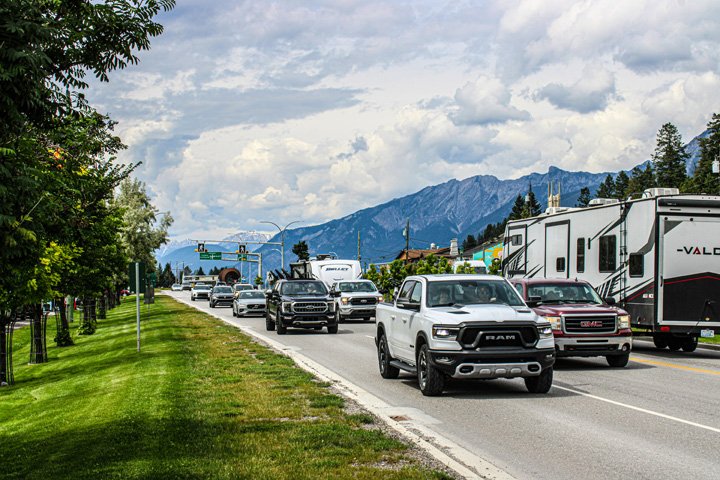
We came off the mesa Monday morning, timed to miss the checkout-day traffic heading the opposite direction. Somewhere on the highway back, we passed a line of trucks and trailers waiting to get into a developed campground for the last night of the weekend — gates closed, host turning people away, the backup stretching back to the highway turn. I’ve been in that line. I understand why it exists. The appeal of the known, the easy, the pre-arranged site with the number on a post.
But from the other side of the glass, driving the other way with four days of quiet canyon country behind me, it doesn’t look like camping. It looks like waiting.
The backcountry was right there the whole time. It always is.