

The last big holiday weekend of summer packs BLM pullouts and forest roads with campers who’ve never dispersed camped before. Here’s how the people who’ve done this for years can make sure everyone leaves it better than they found it.
Every Labor Day weekend, the same thing happens on public land across the West: the sites that held three rigs all August suddenly hold fifteen. Trucks with rental-fleet tires and brand-new rooftop tents nose down two-tracks that, a month ago, only the regulars knew existed. Some of it comes from word-of-mouth. A lot of it comes from an app that flagged a pin without explaining the etiquette that goes with it.
This is Labor Day boondocking’s real character: it’s the one weekend a year when the dispersed camping community stops being mostly people who already know the rules and becomes, briefly, mostly people who don’t. That’s not a complaint. It’s an opportunity, and how the regulars handle it says more about this lifestyle than any gear review ever will.
The Weekend Where Everyone Shows Up At Once
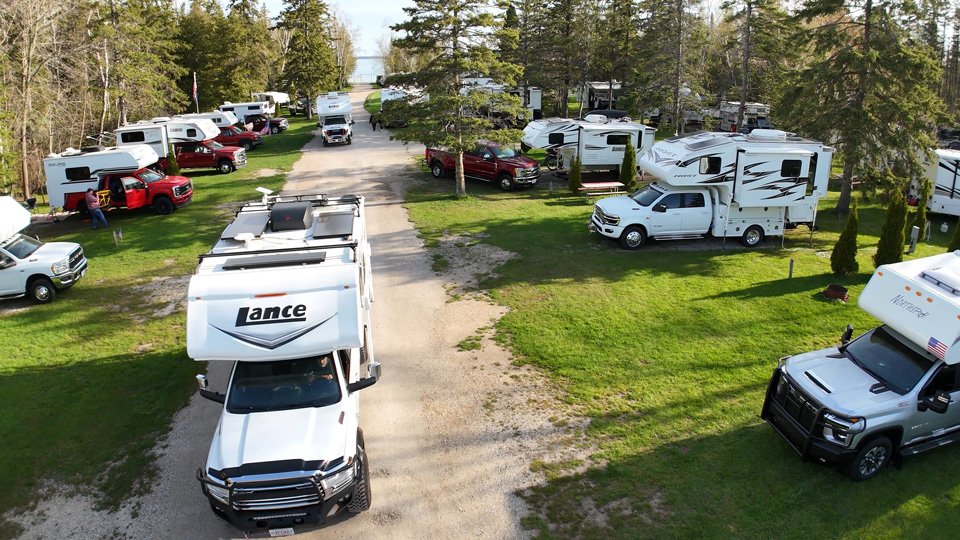
Labor Day draws a different crowd than a random Tuesday in July. It’s families squeezing in one last trip before school schedules lock down, first-time van owners testing out a rig they bought in the spring, and weekend warriors who found a “top 10 boondocking spots” list and picked the first one. None of that is a problem by itself. The problem shows up when forty rigs converge on a drainage built for eight, nobody’s checked a fire restriction map, and half the group has no idea that “leave no trace” means more than not littering.
Longtime boondockers tend to have one of two reactions to this. The first is to get territorial — grumble about the crowds, post cryptic warnings in forums, maybe deliberately withhold information that used to be common knowledge. The second is to treat the influx as exactly what it is: new people discovering something worth protecting, who are one good conversation away from doing it right.
The second reaction is the one that actually keeps public land open. Every dispersed site that’s been gated or closed to camping in the last decade got that way because too many people did it wrong and nobody stepped in to correct course before land managers had to. The instinct to gatekeep information feels protective, but it doesn’t produce better behavior — it just produces worse behavior with less guidance attached.
What Actually Helps
The regulars who make Labor Day weekend better aren’t the ones with the fanciest rigs. They’re the ones who roll down a window and mention, without condescension, that the wash three sites over floods fast if it rains, or that the fire ring the last people left needs to be scattered before anyone uses it. They’re the ones who share a spare gray water jug with a family who didn’t know they’d need one, or point a lost first-timer toward a site that actually fits their rig instead of letting them white-knuckle a road they’re not ready for.
None of this requires a lecture. It requires noticing — a rig parked too close to a wash, trash left where a fire ring used to be, a dog off leash near a site with a posted wildlife closure — and saying something before it becomes a pattern that gets reported to a ranger station and turns into a permanent gate. A short, friendly heads-up from a neighbor lands very differently than a citation, and it’s the version of enforcement this community can actually provide itself.
It also means being honest about capacity. If a favorite dispersed area is already full when you pull in on Friday, the answer isn’t to squeeze a sixteenth rig into a spot built for eight — it’s knowing a second and third option exists, and being willing to point newcomers toward them instead of quietly wishing they’d disappear. Overlanding forums and boondocking apps make it easy to find the popular spot; they’re much worse at communicating when that spot is already at capacity for the weekend.
Leaving the Season the Way You’d Want to Find It
Labor Day is also, functionally, the hinge between boondocking’s busiest season and its quietest one. What gets left behind this weekend — the fire scars, the toilet paper someone didn’t pack out, the ruts cut into ground that was still wet from a monsoon storm — is what the next wave of shoulder-season campers finds in October. The community’s reputation with land managers resets every year around this exact weekend, for better or worse.
None of this means treating newcomers as a burden to be managed. It means recognizing that most people who show up to a dispersed site for the first time this Labor Day want to do it right and simply haven’t been shown how yet. The boondockers who’ve been doing this for years are the only people positioned to show them — not the land management agency, not an app, not a forum post they’ll read after the fact. A five-minute conversation at the fire ring does more for public land access than any rule ever will.
Go into this Labor Day weekend expecting company. Go in ready to be the person who makes someone’s first dispersed camping trip the reason they come back and do it right the next time.