

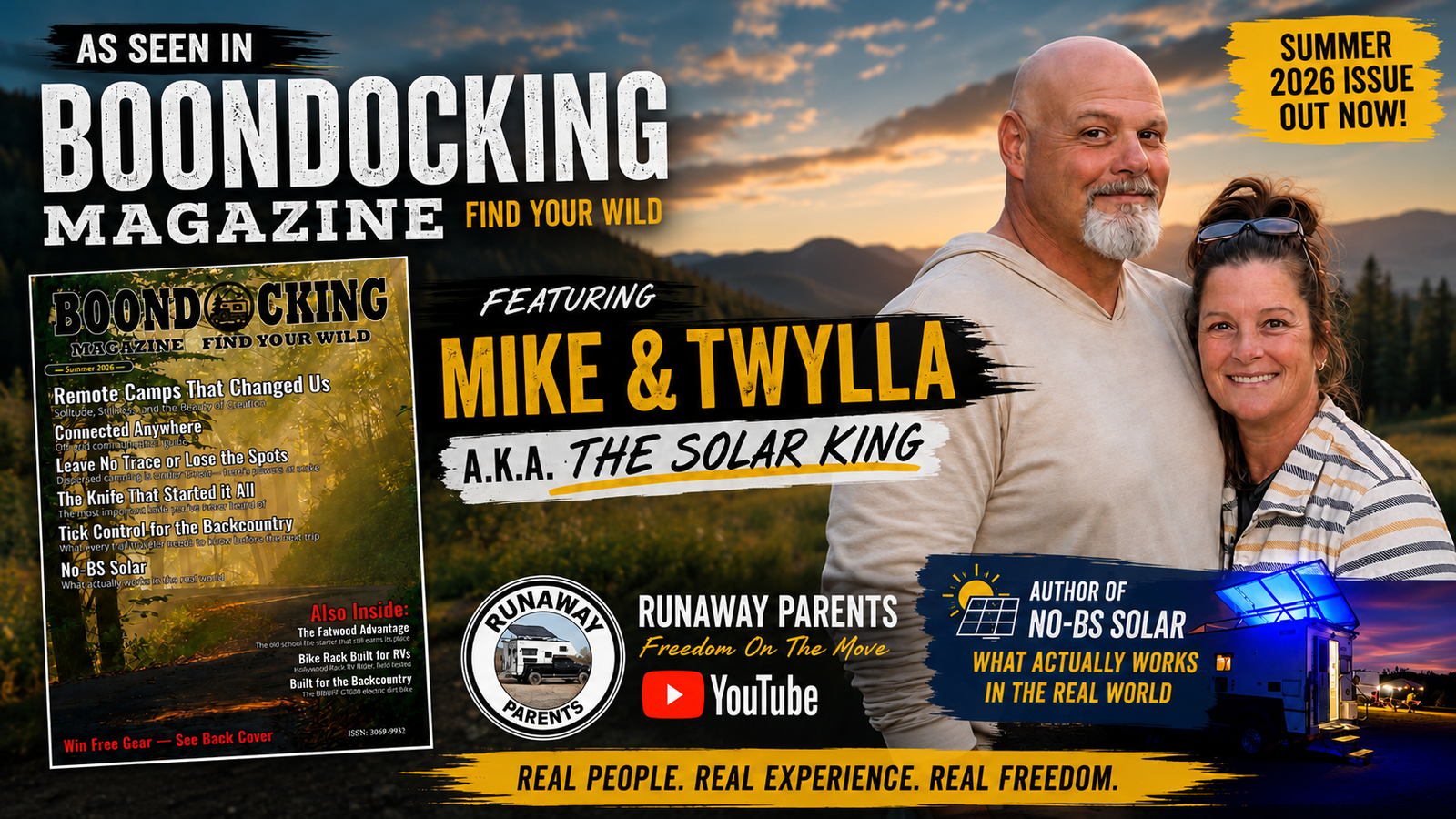
By Mike & Twylla – Runaway Parents
*As featured in the Summer 2026 Edition of Boondocking Magazine*
When people see our truck camper today, they usually assume we bought a high-end, fully built off-grid rig.
We didn’t.
We started with a water-damaged camper, a tight budget, and zero real-world experience with solar. What we did have was a goal — to stay off-grid longer, travel farther, and stop worrying about power every single day.
What followed was a lot of trial and error, a few expensive mistakes, and eventually… a system that actually works.
Not just on paper. Not just in perfect conditions. But in the real world — boondocking for days, running everything we need, and living comfortably without constantly chasing sunlight.
This isn’t about building the “perfect” system. This is about building one that works.
Start With How You Actually Camp
The biggest mistake people make with solar is designing a system based on numbers instead of lifestyle.
You don’t need solar — you need usable power for how you live.
There’s a huge difference between:
- Running lights, a fridge, and charging phones
- Running an inverter, microwave, coffee maker… or even air conditioning
Those are two completely different systems.
For us, the goal was simple:
- Stay off-grid as long as we want
- Run the camper like we’re plugged in, powering air conditioning from batteries and solar
That decision alone pushed us into a much larger system — but it also eliminated limitations.
What We Run (Real-World Setup)
Our current truck camper system is built for capacity, reliability, and recovery — not minimalism. We’re running:
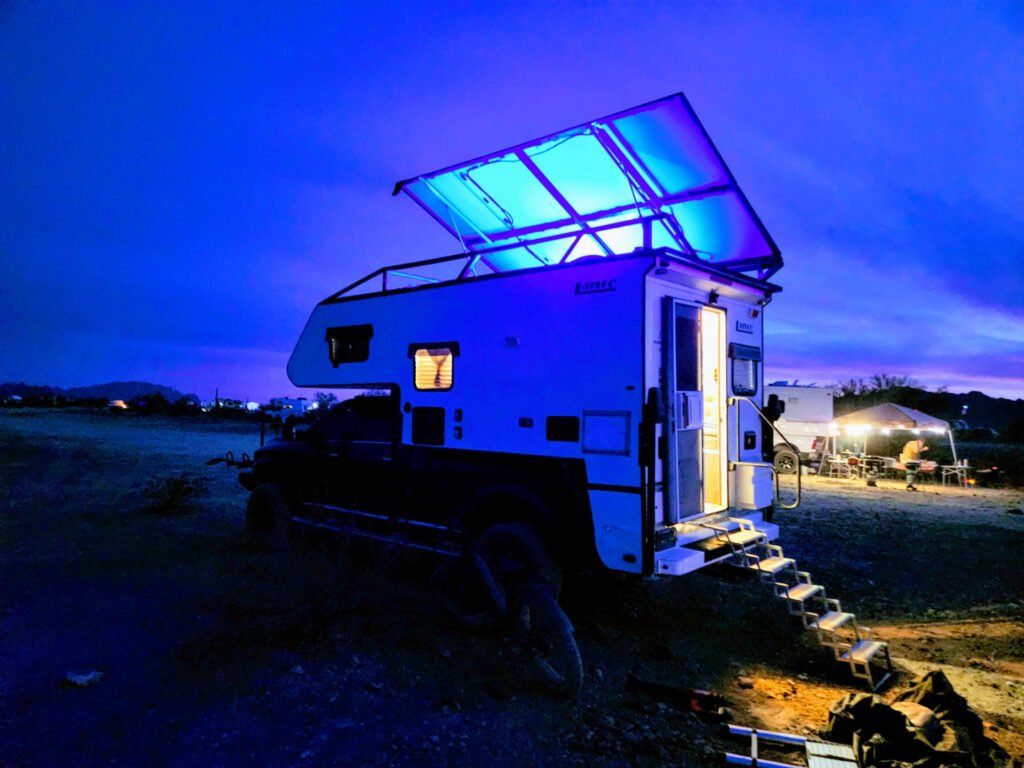
- 1,600 watts of roof-mounted solar on an actuated tilting rack
- Additional portable ground panels (two ZOUPW 480W folding panels)
- Four 24V EG4 LL lithium batteries (server rack style), 800Ah at 24V — over 20kWh of usable storage
- A Victron 24V MultiPlus inverter/charger
- Two Victron MPPT charge controllers
- DC-to-DC charging from the truck while driving
This setup allows us to run the camper like it’s on shore power, stay off-grid longer, and recover quickly after heavy usage days.
We’ve built and tested multiple systems over the years, but this is the one that finally lets us stop thinking about power and just enjoy being off-grid.
In addition to the truck camper, we also built and tow a dedicated off-grid adventure trailer. It’s a 5×10 lifted enclosed cargo trailer outfitted with roughly 800 watts of roof-mounted solar and its own complete power system, including an EG4 6000XP inverter paired with two EPOCH 48V V2 Elite heated batteries — over 10kWh of additional energy storage.
The trailer carries our e-bikes, camping gear, and extra water, while also acting as a mobile power station. It’s equipped with a 30-amp outlet that lets others we’re camping with plug in if needed — something that’s come in handy more than a few times. This setup adds flexibility, redundancy, and extended off-grid capability to our overall system.
Common Mistakes We See All the Time
- Underestimating power needs — Most systems are too small from the start. Real-world use always exceeds expectations.
- Chasing solar instead of storage — Without enough battery capacity, extra solar doesn’t help.
- Overcomplicating systems — More components often mean more problems. Simplicity wins.
- Trusting rated output too much — Real-world conditions rarely match ideal panel output.
How to Size a System That Actually Works
- Determine your daily power usage (watt-hours)
- Add a 20–30% buffer
- Size your battery first
- Size your solar to recharge your usage
Example: If you use 2,000Wh/day, plan for roughly 2,500Wh, keep at least 1–2 days of battery capacity on hand, and make sure you’ve got enough solar to replenish that energy daily.
Lessons Learned From the Road
- Too small always fails — We’ve never regretted having more capacity.
- Simplicity matters — Clean, well-designed systems outperform complicated ones.
- Build for worst-case conditions — not ideal scenarios.
- Comfort changes everything — When you stop worrying about power, off-grid life becomes enjoyable.
What Actually Matters (And What Doesn’t)
What matters:
- Battery capacity
- System balance
- Reliability
- Ease of use
What doesn’t:
- Brand hype
- Peak wattage numbers
- Overly complex setups
Final Thoughts
Build your system for your lifestyle — not for the spec sheet.
Solar isn’t about having the biggest system. It’s about freedom — staying longer, going farther, and not worrying about where you’ll plug in next.
Mike and Twylla are the creators of the YouTube channel Runaway Parents, where they document their journey rebuilding and traveling in their truck camper. Their content focuses on off-grid solar, DIY builds, and real-world overland travel.