

Everyone has a strong opinion. Most of them are wrong. Here’s the truth about which platform actually performs when the pavement ends and the hookups disappear.
Spend five minutes in any camping forum and you’ll find someone ready to die on a hill about their rig choice. Van lifers say trailers are for people who can’t back up. Trailer people say truck campers cost too much for too little space. Truck camper owners don’t say anything because they’re already parked somewhere you can’t get to.
Here at Boondocking Magazine, we’re not interested in what’s cool or what photographs well on Instagram. We care about one thing: which platform actually performs when you’re 30 miles from the nearest anything, your water tank is half full, and you’ve got a week of living ahead of you with nothing but solar and whatever you brought.
The answer isn’t as simple as picking a winner. But it’s also not as complicated as the YouTube algorithm wants you to believe. Let’s break it down honestly.
The Three Contenders
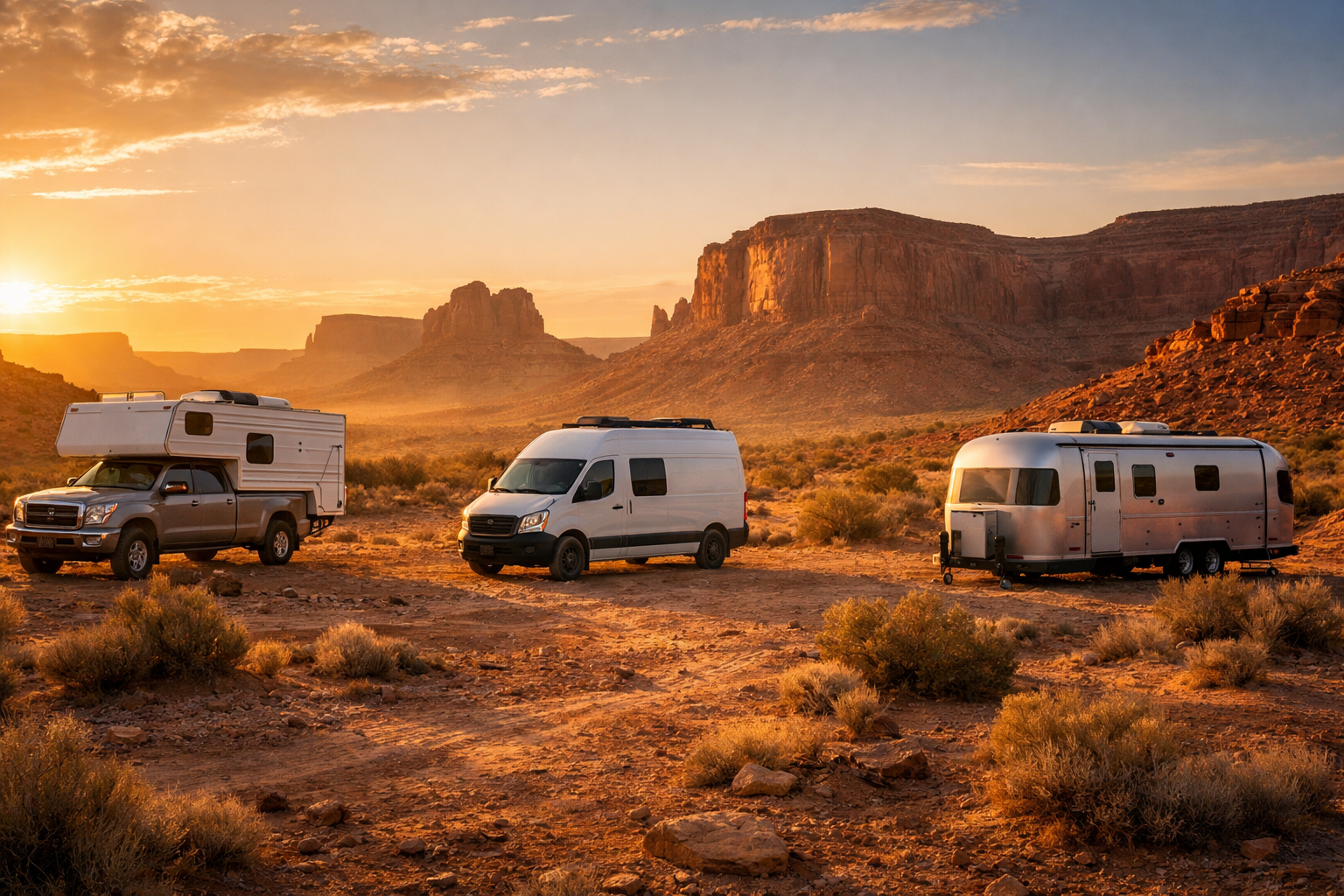
Before we score anything, let’s agree on what we’re actually comparing. This isn’t cargo van vs. Sprinter vs. Class B. This is the three mainstream platforms that serious boondockers use:
Truck camper — a hard-side or pop-up unit that mounts on a pickup truck bed. One vehicle, one unit, no tow vehicle required.
Van conversion — a cargo or passenger van (usually full-size: Ford Transit, Ram ProMaster, Mercedes Sprinter) converted into a living space. One vehicle, period.
Travel trailer — a towable unit pulled by a truck or SUV. Two separate vehicles, disconnectable at camp.
Off-Grid Access: The Only Metric That Matters First
If you can’t get there, nothing else matters. Off-grid boondocking sites — BLM land, dispersed forest camping, remote two-tracks — don’t care about your interior design or your solar array if your rig can’t make it down the road.
This is where truck campers quietly dominate. A truck camper on a 3/4-ton or 1-ton dually handles the same roads the tow vehicle drives. You’re not adding length, you’re not dragging a trailer hitch over ledges, and you’re not white-knuckling a 90-degree turn on a narrow forest road with 28 feet behind you. You park where the truck parks.
Vans split into two camps here. A stock or lightly lifted Transit on 265s can access a lot of terrain — more than people give it credit for — but it tops out well before truck territory. A properly built-out van with a lift, all-terrain tires, and good clearance can push surprisingly deep, but that’s a significant extra investment. Still, for access-to-cost ratio, a good van build does well.
Travel trailers are the most limited here, and there’s no way around it. Even a well-matched tow setup is constrained by the trailer’s width, length, clearance, and the simple physics of backing 24 feet of aluminum down a rutted two-track. That doesn’t mean you can’t boondock with a trailer — millions of people do — but you’re working with a shorter leash.
“If you can’t get there, nothing else matters. Off-grid sites don’t care about your solar array if your rig can’t make it down the road.”
The Scorecard
Here’s how the three platforms stack up across the categories that actually matter when you’re living off-grid. No fluff, no sponsored opinions.
Power & Solar: Where Trailers Quietly Win
Here’s the category where trailers surprise people. A 30-foot fifth wheel or travel trailer has a flat, unobstructed roof that can carry 600, 800, even 1,000 watts of solar without any engineering gymnastics. Add a serious lithium bank, a quality inverter/charger, and you’ve got an off-grid power system that runs a full-size refrigerator, charges laptops, runs lights, and still has headroom. The weight isn’t a concern the same way it is on a truck camper.
Truck campers are more constrained. The roof area is smaller, weight matters more, and the structure has to handle road vibration from the truck cab over rough terrain. A well-built setup like a Renogy ShadowFlux panel array can get you 400 watts or more on a Lance or Arctic Fox without overloading the roof, and that’s enough for serious extended boondocking — but you’re working harder to get there than a trailer owner.
Van roofs are the most limited. A high-roof Sprinter might get you 300–400 watts depending on fan cutouts, vents, and roof rack positioning, and the curved surface makes panel placement less efficient. It’s doable, and plenty of van builds run 200Ah lithium systems effectively, but you’re living more conservatively than a trailer camper with the same budget.
The Real-World Factor Nobody Talks About: Camp Mobility
One thing the trailer comparison almost always misses is what happens after you’re set up. With a truck camper or van, you drive to the store, scout the next campsite, run into town for ice, or explore a canyon without breaking camp. Your home stays put and your vehicle moves.
With a trailer, you either break camp every time you move the truck, or you leave the trailer unattended — which means choosing between convenience and security. Many trailer campers bring a side-by-side or motorcycle as a camp vehicle. That’s a real solution, but it’s also real money, real weight, and real logistics. It’s not a dealbreaker, but it’s a cost the scorecard doesn’t fully capture.
Truck camper owners have this solved by default. Park the camper, unhitch, and go. Van owners have nothing to unhitch at all. For a boondocker who wants to explore the surrounding area without moving base camp, this matters more than almost any other factor day-to-day.
Who Each Platform Is Really Built For
Truck camper
You want to go where trailers can’t. You want one-vehicle simplicity with real off-road capability. You’re willing to pay more upfront for a platform that performs in the backcountry without compromise. You probably don’t need 200 square feet of living space because you’re spending most of your time outside.
Van
You’re a solo traveler or a couple. You want stealth, urban flexibility, and a rig that works as a daily driver. You’re willing to live lean in exchange for ultimate mobility. You’ll likely need to be creative and disciplined with water and power, but you can go almost anywhere and blend in everywhere.
Travel trailer
You want the most living space and solar capacity for the dollar. You’re camping with family or a group. The sites you frequent aren’t the most technical, but you want extended stays with real comfort — real kitchen, real bathroom, real bed. You’re okay leaving the truck at the trailhead and towing home when the trip’s over.
There is no universal winner. The right rig is the one that matches how and where you actually camp — not the one with the best YouTube channel or the most Instagram followers.
The worst rig decision you can make is buying for the platform instead of the life you’re actually going to live. Be honest with yourself about where you’re really going, who you’re going with, and what you need when you get there. The right answer will be obvious.
Boondocking Magazine is dedicated exclusively to off-grid and dispersed camping. No hookups. No reservations. No fluff. Visit us at BoondockingMagazine.com for free digital access to every issue.