

Boondocking: Word Origins, History & Meaning
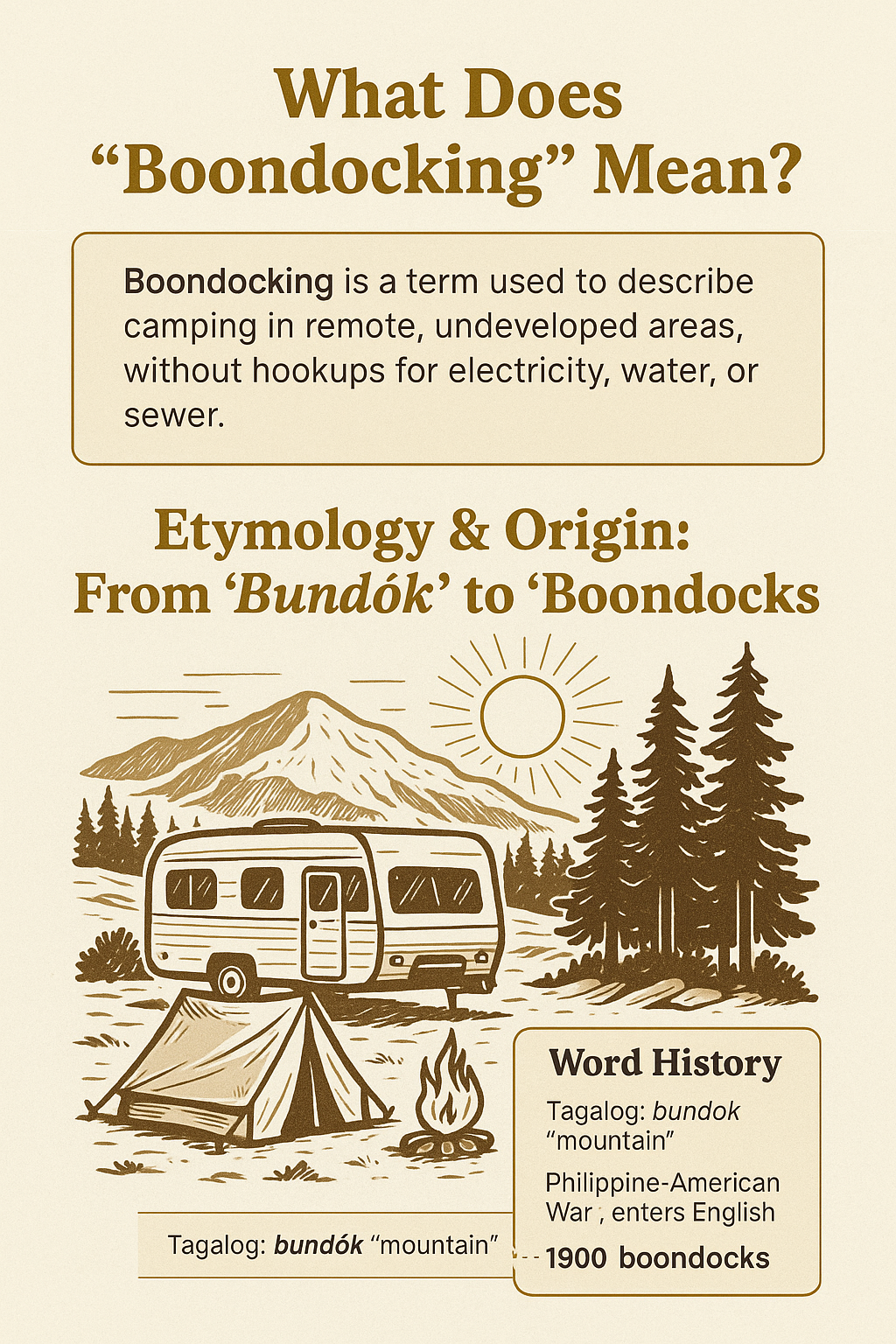
Short version: Boondocking means camping off‑grid without hookups, often on dispersed public lands. The word traces back to the Tagalog bundók (“mountain”), adopted by U.S. soldiers in the Philippines and brought into American English as boondocks (“the backcountry”), later giving us the verb/noun boondocking.
Quick Definition
Boondocking (noun/verb): Camping without hookups (no power, water, or sewer), typically in remote, undeveloped places—often on National Forest or BLM land (aka dispersed camping).
Related terms
- Dry camping: Camping without hookups anywhere (even a paved lot).
- Dispersed camping: Camping outside developed campgrounds on public land.
- The boonies / boondocks: Slang for a remote area.
Where the Word Comes From
Tagalog → American English
- bundók (Tagalog) = “mountain.” U.S. troops serving in the Philippines (1899–1902) picked up the term and anglicized it as boondocks, meaning wild/remote country. citeturn0search0turn0search1turn0search9
- Major dictionaries and etymological references agree on this path into English.
From boondocks to boondocking
- The noun boondocks later spawned boonies (especially common in the Vietnam War era) and, in outdoor/RV circles, boondock/boondocking, describing the act of camping out there off‑grid.
A (Very) Short History
1899–1902 — Philippine–American War
American soldiers adopt bundók → boondocks for the rugged interior.
1927 — First known print citation
Leatherneck (USMC) uses “Boondocks” in a Nicaragua dispatch—the earliest print evidence many researchers cite.
1956 — Word enters U.S. headlines
After the Ribbon Creek tragedy at Parris Island, recruits testified they were sent “out in the boondocks,” pushing the term into national news.
1960s–1970s — The boonies
U.S. troops in Vietnam popularize boonies as shorthand for remote bush and jungle; the term sticks stateside.
Late 20th century → today — Boondocking
RVers and overlanders standardize boondocking to mean self‑reliant, no‑hookup camping, often on public lands.
Meaning Today
For modern campers and RVers, boondocking is less about hardship and more about freedom:
- Self‑sufficiency: Manage your own power, water, and waste.
- Remoteness: Choose undeveloped sites—forest roads, desert flats, high meadows.
- Stewardship: Pack it in, pack it out; follow local rules and stay limits.
Many brands and communities define it alongside dry/dispersed camping; the common thread is no hookups.
Word Notes & Fun Facts
- The “original” boondocks are the Cordillera Central mountains of Luzon in the Philippines—home to UNESCO‑listed Ifugao rice terraces.
- Boonie hats and boondockers (rugged boots) share the same backcountry roots—born from necessity, shaped by hard use, and trusted wherever the trail gets rough.
