

Boondocking feels simple when you’re parked under open sky with no neighbors in sight. But legality is rarely simple. Rules vary not just by state, but by who manages the land, how long you stay, and how you camp once you’re there.
This guide gives you a practical framework to understand boondocking rules nationwide—so you can camp confidently, avoid fines, and help keep access open.

Why Boondocking Rules Vary So Widely
There is no single “boondocking law.” Regulations are written and enforced by different authorities:
- Federal agencies
- State governments
- County land managers
- Local municipalities
Wildlife protection, fire risk, population density, and past misuse all influence how strict a location becomes. A pull-off that’s perfectly legal in one state may earn you a knock on the door in another.
The Big Four Land Managers (Know These First)
Bureau of Land Management (BLM)
Generally the most boondocker-friendly land. Dispersed camping is often allowed unless posted otherwise. Stay limits typically range from 7–14 days.
U.S. Forest Service (USFS)
Dispersed camping is commonly allowed outside developed campgrounds, usually with distance requirements from roads, water, and trails.
National Park Service (NPS)
The most restrictive. Boondocking is typically not allowed outside designated campgrounds unless you have a backcountry permit.
State & Local Lands
Rules vary widely. Some state forests allow dispersed camping; others prohibit overnight use entirely outside designated sites.
Knowing who manages the land matters more than knowing the state name on the map.
Core Rules That Apply Almost Everywhere
Most legal boondocking follows similar patterns:
- Stay limits: Usually 7–14 days within a 30-day period
- Distance rules: Often 100–300 feet from water, roads, or developed sites
- Fire restrictions: Seasonal bans are common
- Vehicle limits: Off-road travel may be restricted
- Leave No Trace: Trash and dumping trigger enforcement
Follow these basics and you avoid most problems.
High-Restriction Areas (Where Travelers Get Tripped Up)
These regions typically require more planning:
- California — Heavy fire restrictions and strong enforcement
- Florida — Limited public land; dispersed camping is rare
- Texas — Very little public land; private permission often required
- Northeast states — Smaller parcels and stricter rules
In these areas, improvisation usually leads to trouble.
Boondocker-Friendly Regions
Western states with large amounts of federal land tend to be more accommodating:
- Extensive BLM land
- Large national forests
- Lower population density
- Clearer dispersed camping policies
“Friendly” does not mean lawless — rules still apply.
How to Verify Rules Before You Camp
Apps help, but they are not authority. To avoid tickets:
- Check the managing agency’s official website
- Look up the local ranger district
- Confirm seasonal fire restrictions
- Read posted signage when you arrive
- When in doubt, assume stricter rules
Common Boondocking Mistakes
Many campers get moved along for reasons they didn’t expect:
- Confusing dispersed camping with roadside parking
- Camping on private land within public boundaries
- Staying too long in one spot
- Assuming “others camp here” means it’s legal
Legality often hinges on behavior, not just location.
How to Camp Without Causing Closures
Closures rarely come from one bad camper — but they start there.
- Keep a low visual profile
- Don’t create new fire rings
- Avoid making new vehicle tracks
- Pack out everything, including food scraps
- Leave if the situation feels questionable
The best boondockers leave fewer traces than they found.
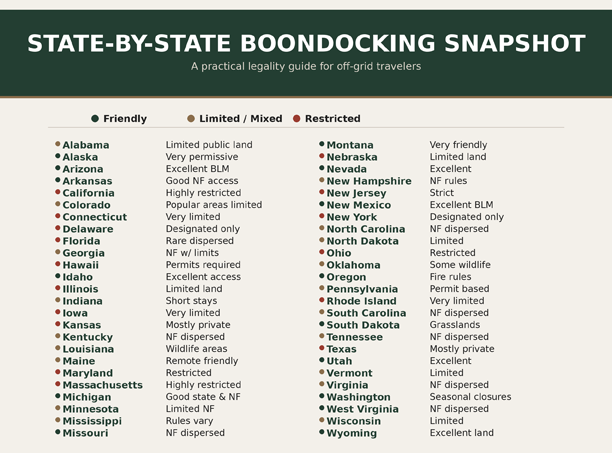
State-by-State Boondocking Snapshot
The chart below is designed as a quick-reference tool showing general trends — friendly, mixed, or restricted — to help set expectations before you travel.
Always verify locally. Fire restrictions and temporary closures override everything.

Final Thoughts
Boondocking access exists because land managers tolerate responsible use. Rules tighten when places are abused, overcrowded, or misunderstood.
Understanding the framework — who owns the land, how long you can stay, and how to behave — matters more than memorizing statutes.
Legal boondocking isn’t about finding loopholes.
It’s about earning the right to stay — quietly, briefly, and respectfully.
Originally published in the Spring 2026 issue of Boondocking Magazine.
Read the full issue:
https://boondockingmagazine.com/digital-edition/